
Introduction: Why STEM Toys Matter More When You’re Raising Kids Abroad
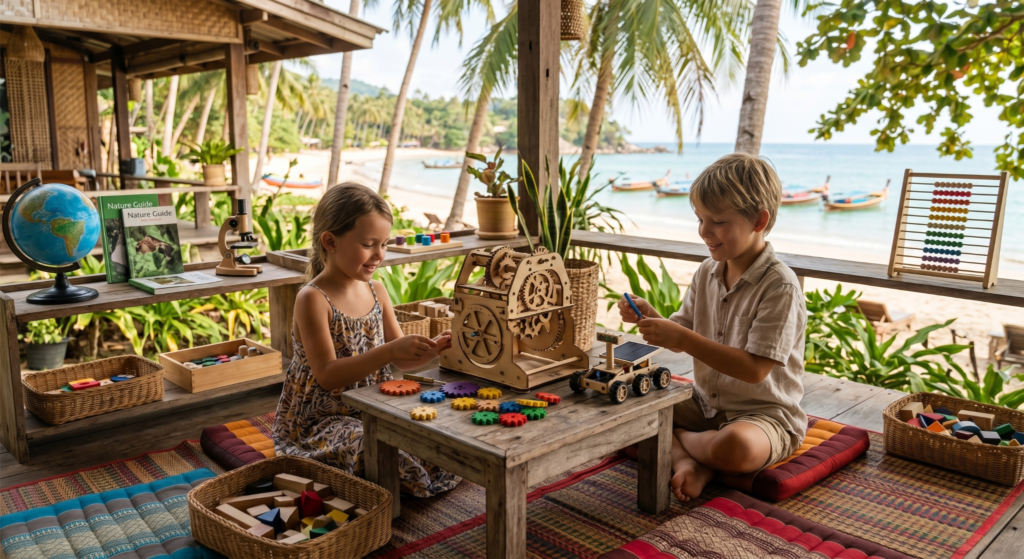
One year ago, I made a decision that changed my family’s life: I left London and moved my
children to Thailand. I didn’t do it for the beaches (though they’re gorgeous). I didn’t do it for Instagram content (though there’s plenty of that). I did it because I realized my kids were growing up with a mum who was present in body but absent in spirit – caught up in the London grind, the corporate ladder, the endless cycle of work-life “balance” that felt more like work-life chaos.
One of the biggest surprises about this move? It completely transformed how I think about my
children’s education and development. In London, I was that mum – you know the one. Signing my kids up for every class, every activity, every “enrichment opportunity.” Piano lessons. Coding camps. Language classes. All in the hope that structured screen time and organized activities would make up for my exhaustion and absence. Then we moved to Thailand.
And something magical happened.
With fewer organized activities available, with a slower pace of life, and with the gift of actually having TIME with my kids, I discovered that the best learning happens not through expensive programs or screen time, but through play. Real, unstructured, creative play. Specifically, through STEM toys that engage their minds, spark their curiosity, and let them learn by
doing.
In this article, I’m sharing what I’ve learned about raising curious, creative kids abroad – and the
STEM toys that have become our secret weapons for development, learning, and screen-free fun.
Part 1: My Story – Why I Changed Everything (And How It Changed My
Parenting)
The London Reality: Parenting on Autopilot
Let me paint you a picture of my life in London before the move.
Weekday mornings: Wake at 6:30 AM, rush kids to school, dash to the office. Lunch eaten at my desk (when I remembered to eat). Pick up kids at 3:30 PM, exhausted. Quick snack. Homework battle. Dinner. Bath time. One rushed bedtime story.
Evenings: Kids in bed, I collapse on the sofa. By then, I’m too tired to be present with my partner. Too fried to enjoy my kids during their waking hours. Too burnt out to think about anything except getting through the next day.
Weekends: Catching up on laundry, grocery shopping, meal prep. “Quality time” squeezed between chores. Kids glued to screens while I caught up on work emails.
I was doing everything “right” on paper. Good job, nice house, respectable school, extracurricular activities. But my kids? They barely knew me. And I barely knew them beyond their behavioural issues and report card grades.
The worst part? I thought this was normal. I thought this was what parenting looked like. What life was supposed to look like.
The Decision: What If There’s Another Way?
The turning point came during a particularly stressful week. My son (then 4) asked me: “Mummy, why are you always so sad?”
That question broke me.
I realized I wasn’t just teaching my kids to grind through life – I was teaching them that striving and stress were the price of success. That being present with the people you love was a luxury, not a necessity. That happiness was something you’d earn someday, when you finally climbed high enough on the ladder.
So I asked myself: What if there’s another way?
What if success looked like time with your kids? What if achievement meant raising curious, creative humans instead of checking boxes on a corporate ladder? What if the best education I could give my children wasn’t classes and credentials, but a mum who was actually present?
Three months later, we moved to Thailand.
The Thailand Reality: Presence Changes Everything
The first month was terrifying. No safety net. No familiar routines. No structure.
But then something shifted.
With fewer organized activities available (honestly, there’s not much choice for English-speaking kids in our neighborhood), we had to get creative. We started having long breakfasts together. We explored our neighborhood. We played.
Real play. Unstructured, messy, wonderfully creative play. And that’s when I discovered the power of quality STEM toys.
Without screens to rely on, without a packed schedule of classes, my kids naturally gravitated toward hands-on activities that challenged their minds. Building sets, coding robots, science experiments. These toys weren’t just entertainment – they were the gateway to learning, creativity, and the kind of brain development that no iPad game could provide.
But more importantly, they gave us TIME together. While my kids were engaged in building, experimenting, and creating, I could sit beside them. Ask questions. Encourage exploration. Actually know what my children were thinking and interested in.
The irony? By stepping off the achievement treadmill, my kids started learning MORE. Not in a structured way, but in the way that actually matters – through curiosity, exploration, and play.
And I became the mum my son asked me to be: present, engaged, and genuinely happy.
Part 2: Why STEM Toys Are Your Secret Weapon for Parenting Abroad (Or Anywhere)
The Science Behind Play-Based Learning
Here’s what the research shows (and what I’ve witnessed firsthand):
Children learn best through play. Not through lectures. Not through apps. Through hands-on, real-world experimentation and exploration.
STEM toys – Science, Technology, Engineering, and Mathematics toys – are designed with this principle at their core. They encourage:
- Problem-solving skills (how do I build this structure?)
- Critical thinking (why didn’t that work?)
- Creativity (what could I build instead?)
- Fine motor development (manipulating pieces, building precision)
- Patience and persistence (trying again when something fails)
- Confidence (completing a challenge independently)
The beauty? Kids don’t feel like they’re “learning.” They feel like they’re playing. Which means they’re more engaged, less resistant, and actually retaining information.
Why STEM Toys Are Perfect for Expat Families
When you’re raising kids abroad, STEM toys become invaluable for several reasons:
1. Language-Independent Learning Construction sets, coding robots, and building challenges work in any language. My kids don’t need to read English instructions (though they can). The learning happens through experimentation, not explanation.
2. Screen-Free in a Screen-Filled World We have more screen time available now than ever before. STEM toys offer an alternative—a way for kids to engage their brains without a device. As someone who moved specifically to give my kids more presence and less screens, this matters enormously.
3. Bridges Cultural Gaps My kids are growing up between two cultures. STEM toys are universal. Building with blocks is the same in Bangkok as it was in London. This creates consistency and familiarity when everything else feels foreign.
4. Develops Confidence in Uncertainty Moving abroad means navigating constant change. STEM toys teach kids that problems can be solved through experimentation and persistence exactly the skills they need to thrive in a cross-cultural environment.
5. Creates Connection Time Without a packed schedule of activities, my kids and I actually have time to play together. STEM toys facilitate this – we build together, problem-solve together, celebrate wins together.
Part 3: The Best STEM Toys for Kids (My Tested & Recommended Picks)
After three years of parenting abroad, testing dozens of toys, and watching what actually captures my children’s attention and feeds their development, here are my top picks:
1. Building & Construction Sets
Why They Matter: Construction toys teach spatial reasoning, engineering concepts, and problem-solving. They’re also wonderfully screen-free and can entertain kids for hours.
Top Picks:
LEGO Classic Large Creative Box
- Age: 4+
- Why I love it: Open-ended creativity. No instructions required. Kids build whatever they imagine.
- Best for: All ages. My 5-year-old and 10-year-old both love it.
- Investment: Mid-range ($50-70)
Magna-Tiles/Magnetic Building Blocks
- Age: 2+
- Why I love it: Satisfying to use, beautiful to look at, teaches 3D thinking.
- Best for: Younger kids (2-7), though older kids enjoy the challenge of complex builds.
- Investment: Higher ($80-150 for quality set)
- Pro tip: Worth every penny. These toys last forever and actually teach geometry.
- Age: 7+
- Why I love it: Teaches engineering and structural design. Builds confidence when kids create working models.
- Best for: Kids who like a challenge and problem-solving.
- Investment: Mid-range ($30-60)
2. Coding & Logic Toys (Screen-Free)
Why They Matter: Coding teaches logical thinking, sequencing, and problem-solving. Screen-free coding toys teach these skills without screen time.
Top Picks:
- Age: 3+
- Why I love it: Teaches programming logic without screens. Kids move physical blocks to program the robot’s path.
- Best for: Young kids who aren’t ready for screen-based coding.
- Investment: Higher ($99-129)
- Real talk: This is an investment, but it teaches genuine coding concepts in an age-appropriate way.
- Age: 3+
- Why I love it: Simple, durable, teaches sequencing. Kids program the robot to move in patterns.
- Best for: Introducing coding to young kids.
- Investment: Mid-range ($50-70)
- Age: 5+
- Why I love it: Kids draw color-coded lines, and the robot follows them. Combines art and logic.
- Best for: Creative kids who like hands-on learning.
- Investment: Mid-range ($50-80)
3. Science Experiment Kits
Why They Matter: Science kits make learning tangible. Kids see cause-and-effect, understand how the world works, and develop a love of discovery.
Top Picks:
National Geographic Crystal Growing Kit
- Age: 8+
- Why I love it: Magical, educational, teaches patience (crystals grow over days).
- Best for: Kids who love nature and visible results.
- Investment: Budget-friendly ($15-25)
Thames & Kosmos STEM Experiment Kits
- Age: 8+
- Why I love it: Comprehensive kits with real science. Well-designed instructions.
- Best for: Curious kids who want real experiments.
- Investment: Mid-range ($25-50)
- Age: 5+
- Why I love it: It’s silly, it’s fun, AND it teaches polymer science. Win-win.
- Best for: Kids who need tactile, messy fun.
- Investment: Budget-friendly ($10-20)
4. Engineering & Structural Design
Why They Matter: These toys teach physics, problem-solving, and the satisfaction of building something that actually works.
Top Picks:
- Age: 8+
- Why I love it: Kids build real circuits. They learn electronics while feeling like engineers.
- Best for: Kids interested in how things work.
- Investment: Mid-range ($30-60)
- Game-changer: My 10-year-old was obsessed with this for months.
- Age: 6+
- Why I love it: Teaches gravity, momentum, structural design. Beautiful to watch.
- Best for: Kids who love watching their creations “work.”
- Investment: Mid-range ($30-80)
Investment: Budget-friendly ($15-40)
Age: 8+
Why I love it: Teaches spatial reasoning. Satisfying to complete.
Best for: Kids who like puzzles and engineering.
Part 4: How to Use STEM Toys to Create Screen-Free Time (And Actually Enjoy It)
Strategy 1: Create a “STEM Corner”
Designate a space in your home where STEM toys live. Keep them accessible. Let kids know this is their creative zone.
The magic? When toys are visible and accessible, kids gravitate toward them naturally. No need to force screen-free time.
Strategy 2: Rotate Toys
Don’t have all toys out at once. Rotate every 2-3 weeks. Fresh toys = fresh interest = extended engagement time.
Strategy 3: Join In (Sometimes)
The best moments aren’t when kids play alone. They’re when you sit beside them, ask curious questions, and genuinely engage with what they’re creating.
“Tell me about what you’re building.” “What happens if you try this?” “How could you make it stronger?”
These moments are where real learning—and real connection—happens.
Strategy 4: Embrace the Mess
STEM toys often involve pieces, parts, materials. Expect mess. Embrace it. This is where learning happens.
Pro tip: Keep a storage box handy for quick cleanup. Kids are more willing to play with toys they know they can contain.
Part 5: The Real Benefits I’ve Seen (Beyond the Learning)
After three years of using STEM toys as a core part of our parenting strategy, here’s what I’ve observed:
My kids are more confident. When they solve a problem independently (“I built a bridge that didn’t fall!”), they feel capable. This confidence transfers to other areas of their lives.
They’re more resilient. Building things falls apart. Experiments fail. Instead of giving up, they try again. This persistence is life-changing.
They’re more creative. Without a packed schedule of directed activities, they’ve learned to entertain themselves creatively. This is a gift.
We have more quality time. We’re not rushing from activity to activity. We’re sitting together, building, experimenting, laughing.
They’re less reliant on screens. Not because I’ve banned them, but because they’ve discovered better things to do.
Part 6: Budget-Friendly Tips for Building a STEM Toy Collection
I know quality STEM toys can be expensive. Here’s how I’ve built our collection without breaking the bank:
1. Start with one quality investment ($50-100) Choose one toy that appeals to your child’s interests. Watch how they engage. This tells you what to buy next.
2. Mix price points Combine expensive toys (like Magna-Tiles) with budget-friendly ones (like crystal kits). Kids don’t care about price—they care about engagement.
3. Buy from Amazon Use affiliate links (like the ones in this article ). You’re buying quality toys AND supporting creators who review them honestly.
4. Look for sales Prime Day, back-to-school, Black Friday. These are great times to invest in quality toys.
5. Sell toys your kids outgrow Use Facebook Marketplace or local expat groups to sell toys they’ve aged out of. Reinvest the money in new STEM toys.
Conclusion: The Real Gift We Give Our Children
When I decided to leave London, I wasn’t thinking about STEM toys. I was thinking about presence. About being a mum who was actually there for her kids.
But what I discovered is that presence and learning aren’t separate things. They’re connected.
STEM toys became the bridge – they gave my kids something engaging to do, AND they gave us time to be together while they did it. They taught my kids to think critically and solve problems, AND they taught them that learning is play.
Whether you’re raising kids abroad or in your hometown, whether your children are in London or Thailand, the principle is the same:
Quality toys, combined with your presence, create the conditions for real learning and real connection.
The best education our children can receive isn’t more classes or more credentials. It’s a parent who is present, curious, and engaged. It’s a childhood full of play, experimentation, and the freedom to explore.
And it starts with STEM toys that spark wonder.
About the Author
I’m a British mum who left London to raise my family in Thailand. What started as a search for presence became a complete reimagining of how we approach parenting, learning, and childhood.
Now I share real stories about expat motherhood, creative parenting, and finding joy in the unexpected places – especially when your children learn best through play.
Welcome to my world. I’m so glad you’re here.
Affiliate Disclosure: This article contains Amazon affiliate links. I recommend only products I genuinely use and believe in. When you purchase through these links, I earn a small commission at no extra cost to you. Your support helps me continue creating honest, valuable content for parents navigating unconventional journeys.
Leave a Reply