Most articles about moving to Phuket with children read like a property brochure. Beautiful photos, vague mentions of “affordable living,” a list of international schools, and nothing about what it actually feels like to pack up your life and land in a foreign country with a child who is looking at you to make this okay.
This is not that article.
Living in Phuket as a single parent with a school‑age child means juggling school fees, immigration, friendship, and homesickness alongside the usual parenting load — and doing it all in a place that is both astonishingly beautiful and, at times, brutally confronting. You will be the one who makes this move feel safe, even on the days when you do not feel safe yourself.
This is the guide that would have saved months of second‑guessing, late‑night spreadsheeting, and “are we completely mad?” conversations before getting on the plane.
The Real Cost of Moving to Phuket as a Family
Let’s start with the number nobody puts in their Instagram caption.
Comfortable expat family life in Phuket in 2026 costs approximately 160,000 THB per month — roughly £3,600 — for a single parent with one school‑age child. That figure assumes a modern home with a pool in an expat‑friendly area, international school fees, food, transport, utilities, health insurance, and a modest buffer for extras like weekend trips or activities.
The number surprises almost everyone, because the “cheap Thailand” narrative is so persistent online. It was more accurate years ago and still holds in some northern cities like Chiang Mai, where housing and schooling are significantly cheaper, but it does not hold in Phuket, where demand from digital nomads, long‑term tourists, and investors has pushed prices up. International school fees alone can run 350,000–1,000,000 THB per year per child once you include tuition, application fees, building fees, and extras.
Here is where that money actually goes in 2026 for a typical single‑parent, one‑child household:
Housing (40,000–70,000 THB/month) A comfortable family home with a private or shared pool in an expat‑oriented area near good schools (Laguna, Cherng Talay, parts of Koh Kaew) sits in this range. You can go cheaper by moving further from the schools or choosing an older Thai‑style house, but you will trade off convenience, safety, and sometimes basic comfort like good wiring, pest control, or soundproofing.
International school (30,000–85,000 THB/month) This is the category that breaks most pre‑move budgets. Annual tuition is usually billed termly and often excludes lunch, uniforms, and activities. Once you spread the yearly cost over twelve months and add the smaller fees, this becomes a major line item that can easily rival or exceed your rent.
Food (15,000–25,000 THB/month) A family eating a mix of local Thai food and Western groceries lands around this range. Regular local markets and Thai restaurants keep costs down; imported cheese, cereal, gluten‑free or specialty products, and frequent café visits push it up.
Transport (10,000–15,000 THB/month) This usually covers a car or motorbike rental or finance payment, fuel, basic maintenance, and the occasional taxi or Grab. If your child’s school is not on a bus route or is far from home, factor in a lot of driving — and time — for the school run.
Health insurance (5,000–8,000 THB/month) Private hospitals in Phuket are excellent, but they are cash‑based: you are expected to pay or show proof of insurance before treatment. A good international or regional health plan for a parent and one child is non‑negotiable, not a luxury.
Everything else (10,000–20,000 THB/month) Utilities, mobile plans, visas, weekend activities, clothes (which may be more expensive than at home if you need Western brands or sizes), tutor sessions, sports clubs, and the inevitable “Mum, my school trip is next week and we have to pay today.”
Budget honestly before you come. Families who struggle financially are almost always the ones who planned around the lowest estimates they read online or forgot to account for things like visa runs, school application fees, or furnishing a house from scratch.
International Schools in Phuket — What You Need to Know
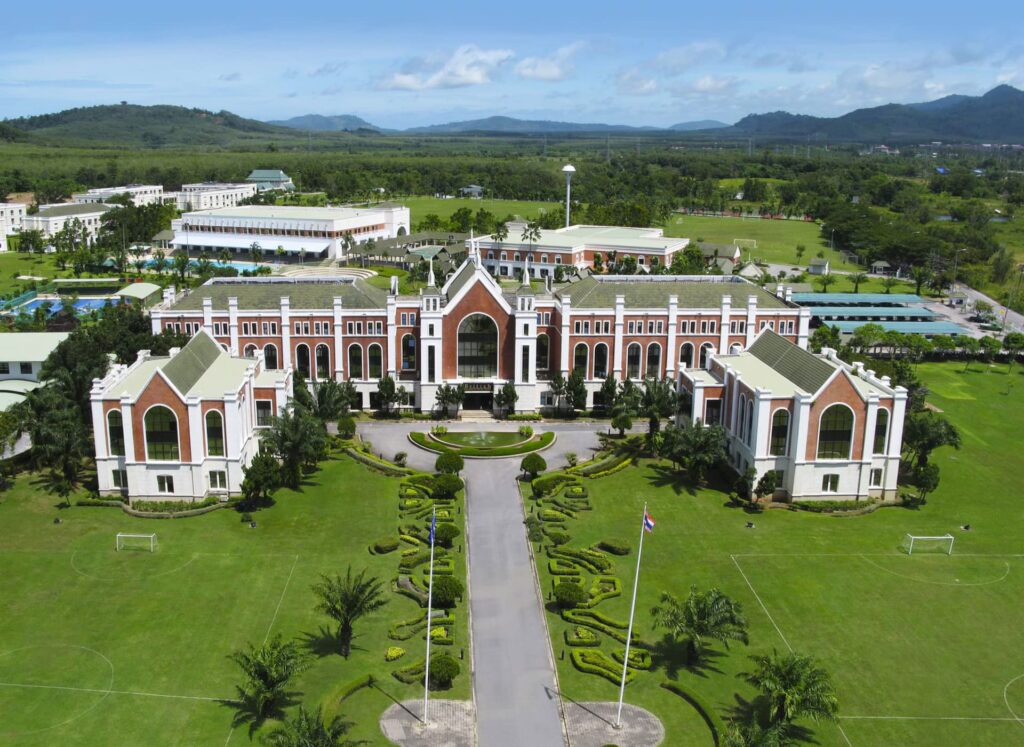
The international schools in Phuket are, in many cases, genuinely excellent. Small class sizes, experienced teachers, and pastoral care that pays real attention to social and emotional well‑being are common in the established schools. Your child will likely share a classroom with students from dozens of countries, and that day‑to‑day cultural mix can be one of the most rewarding parts of the entire move.
Three schools dominate expat family conversations:
British International School Phuket (BISP) BISP is the flagship school on the island, with a British‑based curriculum through to A‑levels, extensive sports facilities, and strong university placement into the UK, Europe, and beyond. It is also one of the most expensive options, with annual fees around 600,000–950,000 THB depending on age and programme, plus additional fees. Boarding exists but most Phuket‑based families attend as day students, and popular year groups can have waiting lists, so applying 12 months ahead is wise.
HeadStart International School HeadStart offers the Cambridge curriculum, strong academics, and is known for its warm, community‑oriented environment, making it a popular mid‑range choice. Tuition commonly falls in the 350,000–550,000 THB per year bracket, which is still a substantial cost but noticeably below the very top tier. Like BISP, some classes fill up, so families planning a move should not assume immediate availability.
UWC Thailand UWC Thailand runs the International Baccalaureate (IB) from primary through to the Diploma Programme and is part of the global UWC movement focused on diversity, peace, and sustainability. The student body tends to be deeply international and the ethos strongly values‑driven, which some families find life‑changing and others find too intense or not aligned with their priorities. Visiting with your child, if possible, matters more here than simply comparing fees and facilities.
There are smaller and newer schools, bilingual programmes, and local Thai schools with English tracks as well, which can work for younger children or families on a tighter budget. But one rule almost every long‑term expat family in Phuket agrees on: do not move without a confirmed school place. The best schools often have waiting lists of six to twelve months in key year groups, and arriving “to sort it when we get there” is a common and stressful mistake.
Where to Actually Live
Phuket is larger and more fragmented than it looks on a holiday brochure. Driving from the far north to the far south takes over an hour, and traffic around school start and finish times can be intense on certain routes. Where you live will shape your daily life even more than which beach is closest.
Here are the areas most talked about by expat families with children:
Laguna and Cherng Talay (Bang Tao area) This is where many school‑age expat families end up. The area has easy access to several international schools, good private healthcare, and Bang Tao beach, along with cafés, supermarkets, and fitness studios that cater heavily to foreigners. Rents are higher — think 40,000–80,000 THB per month for a family home with a pool — but the trade‑off is a walkable or short‑drive life with a ready‑made community.
Rawai and Nai Harn (South) The south feels more relaxed and more local, with a slightly slower pace and a strong long‑term expat presence. Nai Harn beach regularly appears on lists of Thailand’s most beautiful beaches, but living here often means a longer daily drive to schools in the central or northern part of the island, which can be tiring when done twice a day.
Phuket Town Often overlooked by new arrivals, Phuket Town offers lower rents, local markets, cultural events, and photogenic Sino‑Portuguese architecture. It can be a better fit for families who want to experience Thailand more deeply rather than lean fully into an expat bubble, though you will likely spend more time in the car going to schools, beaches, and extracurricular activities.
A simple rule of thumb: choose your school first, then choose where to live based on the school run, not the beach. A 15‑minute commute that you do four times a day quickly becomes more valuable than an extra bedroom.
The Emotional Reality Nobody Writes About
Moving to Phuket with children is harder than you think and better than you imagined — sometimes on the same day.
The hardest part is rarely the bureaucracy or the logistics. It is the quiet loneliness that can show up on Sunday evenings when the novelty wears off and you realise your oldest friends are now a continent and several time zones away. Expat communities are by nature transient; people come for a year or two, fall in love or burn out, and leave often just when you start to feel close. You do the emotional labour of starting again more often than you anticipated.
Your child, on the other hand, will almost certainly adapt before you do. Children step into new cultures with an openness that adults have to work at consciously. Within a few months they will drop Thai words into conversation, have favourite foods from the school canteen, and talk about Phuket as simply “home,” not as “this place we moved to.” Following their lead — exploring, learning Thai together, building new routines — can make your own adjustment gentler.
There will be a moment when it quietly clicks. It might be at immigration, when you handle a visa extension that would have terrified you six months earlier, or at a parents’ coffee morning where you realise you actually know people. You will notice that you are no longer performing the role of “person who has moved her family to Thailand” — you are simply living your normal life, which now happens to include palm trees and afternoon rainstorms.
Give it a year before you judge it. The best version of life in Phuket is almost never available in the first three months, when everything is still logistics, paperwork, and “where do you buy…?” conversations.
The Practical Things to Sort Before You Leave
In rough order of urgency for most families:
Visa research In 2026, the Destination Thailand Visa (DTV) is designed for long‑stay visitors with remote income, freelancers, and certain categories of skilled workers looking to live in Thailand for extended periods. Families with online businesses or remote roles often find this the most practical route, but you must check that your income, activities, and stay plans meet the current rules.
Document apostilling Birth certificates, marriage certificates, and school records often need to be legalised (apostilled) by the issuing country’s foreign office for use in Thai immigration or school enrolment.
School applications Start this before anything else, ideally 12 months before you plan to arrive. Popular year groups at BISP, HeadStart, UWC Thailand, and other established schools can fill up, and applications often require previous school reports, references, and entrance assessments.
International health insurance Arrange this before leaving home, not after arrival. Many policies have waiting periods and exclusions that start from the policy date, and some visas or schools may ask for proof of coverage.
Banking and money transfers Setting up a Wise (formerly TransferWise) account or a similar low‑fee international transfer service makes moving money from your home country to Thailand much cheaper than traditional banks. When you are sending school fees and rent, even small percentage differences in fees add up quickly.
Passports and timeframes Every family member’s passport should have at least 18 months of validity when you move. Many visas, extensions, and re‑entries are tied to passport expiry dates, and renewing from abroad is possible but slower and more complex than doing it before you go.
Having these pieces in place does not remove all the stress, but it means that when you hit the inevitable wobbles — homesickness, a school issue, a visa queue that takes four hours — you are not also worrying about expired documents or missing insurance.
Is It Worth It?
Families on the edge of this decision often ask some version of the same question: “Are we crazy to even consider this?”
The honest answer: for the right family, yes, it is worth it. Not because it is easy. It is not. It is worth it because it is the kind of hard that makes you grow in ways that staying put rarely does. Your children will have a childhood shaped by warmth, diversity, outdoor life, and an everyday awareness that the world is bigger than one country or culture. They will collect friends from all over the globe and think nothing of switching languages on the playground.
For the wrong family — one where the income is uncertain, the relationship is already under strain, or the move is primarily about escaping problems at home rather than moving toward something intentional — Phuket will almost certainly magnify existing cracks rather than mend them. The sunshine and sea do not magically dissolve money stress or relationship issues; they sometimes highlight them by removing distractions.
The decision point is simple, but not easy: know which kind of family you are, and be brutally honest about your finances, your reasons, and your resilience. Then decide.
If you want the complete picture, The She Moved Guide to Moving to Thailand With Kids is a 44‑page guide that goes deeper into real costs with sample budgets, side‑by‑side school comparisons, current visa options, neighbourhood breakdowns, child safety, cultural essentials, and the emotional reality of building a life here — written from Phuket by someone actually living it day to day.




Leave a Reply